
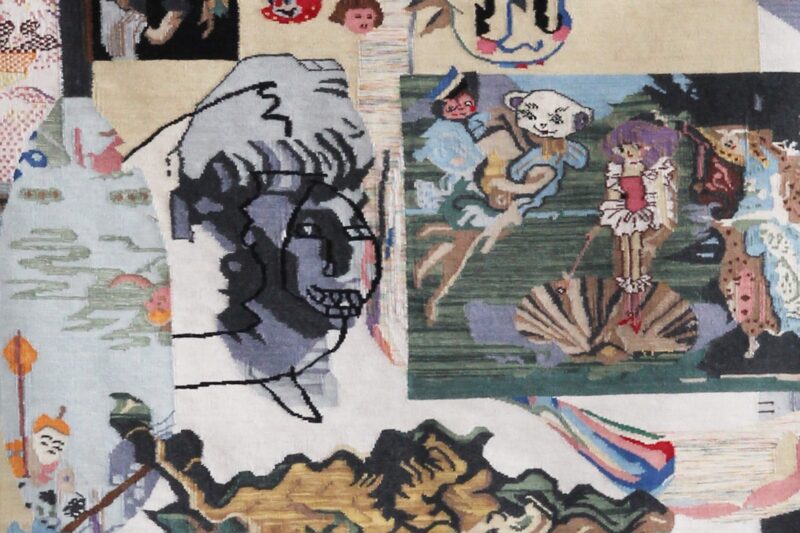
Wie-yi T. Lauw, Fleeting universe (Detail), 2021, Wolle, Baumwolle, handcoloriert, Tapisserie, (c) Wie-yi T. Lauw
Artists: !Mediengruppe Bitnik, Nora Al-Badri, Klara Källström & Thobias Fäldt (mit Thomas Sauvin und Bernard Dionysius Geoghegan), Nihad Kreševljaković, Mail Art Archive of Ruth Wolf-Rehfeldt and Robert Rehfeldt, PPKK (Schönfeld & Scoufaras), Sarah Oh-Mock und Bongjun Oh, Sim Chi Yin, Clarissa Thieme, Wie-yi T. Lauw
Wed, 7.10.2026, 6 pm
Welcome: Katrin Röseler-Soult, Head of the Arts and Culture Division (interim), Lichtenberg District Office, Berlin
Introduction: Julia Heunemann, Lusin Reinsch and Ulrike Riebel
Archives collect, organize, and preserve records of the past in the form of documents, images, voices, objects, and data. Every decision about what they preserve is also a decision about what will be passed on to the future. Archives, therefore, do not merely manage the past. They also shape the conditions under which history can be remembered, recounted, and interpreted in the future.
Future Archives / Archive Futures takes this temporal intertwining as its starting point and considers archives as infrastructures of possible futures. The group exhibition explores how the conditions of archiving are changing and what other forms of memorization, oral tradition, and knowledge production may emerge from this.
In the digital age, archival practices and perspectives are undergoing a fundamental shift. Databases and algorithmic systems are expanding the possibilities for storing, organizing, and circulating knowledge, while artificial intelligence no longer merely processes existing material but actually generates images, texts, and voices on its own. In the process, the boundaries between document and construction, historical evidence and synthetic memory, are becoming increasingly blurred.
The destabilization of archival authorities also offers the opportunity to think about archives differently: in a more decentralized, polyphonic, and collaborative way. This allows established orders to be critically and constructively questioned, and enables those whose stories are archived to become producers and interpreters of memory themselves. The archive thus appears less as a place where history is codified and more as a social space where different forms of knowledge converge, are negotiated, and are passed on. The key question then concerns both what is preserved, but also by whom, for whom, and under which conditions.
The exhibition title Future Archives / Archive Futures traces this dual movement: It explores what the archives of the future might look like—but also which futures are already being created by archives today.
Curated by Julia Heunemann, Lusin Reinsch, and Ulrike Riebel